Before you spend real money on AI, get an honest verdict.
For the decisions that would cost you real money or months if they were wrong. Bring one. Five business days later you have GO, FIX or STOP, the reasoning, the dissent, and a dated audit trail you could put in front of a board or a bank.
What it is
Every vendor is paid to say yes. A consultant who makes money on the build will tell you to build. One chatbot gives you one fluent answer and no dissent. Nobody in that chain is paid to give you the one answer that saves you the most, which is stop.
The Ideas Lab is built to be paid for the right call rather than the green light. The criteria for a GO, the budget cap and the point at which the answer becomes STOP are agreed and signed before any work starts, so the goalposts cannot move. Then a panel of competing frontier models works the question independently, their positions are cross examined, the commercial case is attacked on purpose, and a person accountable for the call reads the result and gives you the verdict.
This is for you if
- A wrong answer would cost you real money or months
- Somebody is already paid to tell you yes
- You want a decision you could put in front of a board or a bank
Not for you if
- You have already decided and want it endorsed
- The question needs a build to answer; that is a pilot
- You want legal, tax or financial advice
How it runs
The same four stages run on every decision, so the verdict is trustworthy by construction rather than by reputation.
- 1 · Day 0
Lock the criteria
We write down what a GO would have to look like, the budget cap, and the kill criteria. You sign it. From here the question cannot be redefined to fit the answer.
- 2 · Days 1 to 2
Convene the panel
Several frontier models work the decision independently, each from a different position, so no single model's blind spots decide the outcome. You choose which models sit on the panel and we capture your data handling preferences first.
- 3 · Day 3
Adversarial review
The positions are cross examined. The commercial case is attacked. Weak reasoning is exposed and the dissent is recorded rather than smoothed over.
- 4 · Day 5
The verdict
GO, FIX or STOP, with the reasoning, the conditions and the risks named, and the full dated audit trail attached. We stop the moment the question is answered.
In writing, before we start
Three sentences that hold on every engagement. They are the method, written as promises.
The measure, the budget cap and the point at which we stop are set in the written scope before anything is billed. Nothing moves the goalposts afterwards.
Everything we build runs in your accounts and is yours: code, configuration, documentation and measurements. We hand over; there is no dependency on us.
If the pilot does not hit the measure we agreed first, we keep working at no further cost until it does, or we stop and say so in writing. You will not be sold the next step by the first one.
What to bring
Should we build this?
- A product or feature idea
- An automation project
- A build or buy decision
Is this vendor worth it?
- A SaaS or platform decision
- An agency or vendor proposal
- A contract renewal
Where do we start with AI?
- Prioritising AI initiatives
- Choosing a first project
- A board or budget case
What it is not for
- A decision you have already made and want endorsed
- Anything that needs a build to answer; that is a pilot
- Legal, tax or financial advice
What the pack looks like
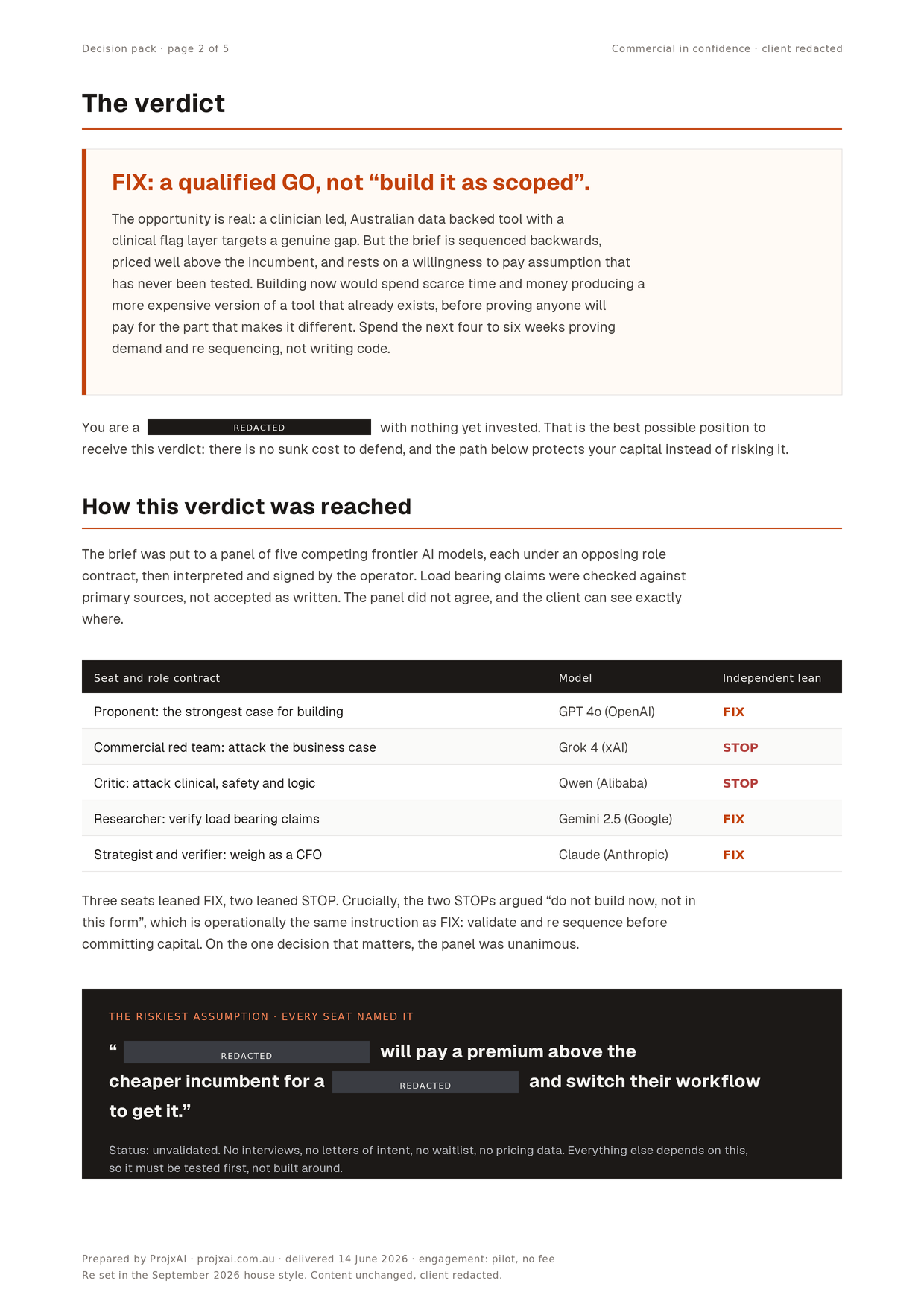
Page two of a decision pack, client redacted. The structure is the same on every decision.
- A signed pre commit sheet: success criteria, budget cap and kill criteria
- The decision pack: verdict, reasoning, dissent, riskiest assumptions and the audit trail
Questions
Why a panel of models instead of one?
One model gives you one confident opinion and no dissent. Competing models with different strengths and blind spots surface disagreement you can learn from. They are cross examined, the dissent is recorded, and a person interprets the result, so you get judgement rather than output.
What makes it governed?
Three things, all in writing: success criteria, budget cap and kill criteria locked before work starts; an adversarial review where the case is attacked rather than rubber stamped; and a dated audit trail behind every verdict.
What if the verdict is STOP?
Then you hear STOP, plainly, with the reasoning. A A$750 STOP that saves a A$50,000 build is the best money you will spend this year, and it is the answer we are proudest of giving.
Where does our data go?
You choose which models sit on the panel. Personal information is pseudonymised before anything crosses to a model, and we work within your Privacy Act 1988 obligations. The pack and the audit trail are yours.
What happens after a GO?
Usually a paid pilot to prove the first slice on your real data, then implement and expand. Each step is priced on its own; a GO commits you to nothing.
Got a decision worth getting right?
Tell us the decision in a sentence. We will say whether it belongs on the panel, and if it does, the criteria conversation is the first fifteen minutes.